


⏱ 6 min read
In the rapidly evolving landscape of the Architecture, Engineering, Construction, and Operations (AECO) industry, staying ahead of the curve is no longer just an advantage it is a necessity. As digital transformation sweeps across global construction markets, Building Information Modeling (BIM) has emerged as the backbone of modern project delivery. At the forefront of this educational revolution is the BIM Certification Course offered by Pinnacle IIT, a program designed to bridge the gap between traditional engineering education and the high-tech demands of today’s construction world.

Why You Need a BIM Certification Course in 2026:-
The construction industry is shedding its image as a slow-to-adopt sector. Today, we talk about digital twins, smart cities, and automated project management. However, the tools are only as effective as the hands that wield them. This is where a comprehensive BIM Certification Course becomes the defining factor in a professional’s career trajectory. f you are wondering where this path leads, check out the Global Guide to Salary & Career Growth for BIM Professionals.
Whether you are a fresh civil engineering graduate, an experienced architect, or a MEP (Mechanical, Electrical, and Plumbing) specialist, understanding the nuances of BIM is essential. The transition from 2D drafting to 5D or even 7D BIM integration represents a massive leap in how we visualize, execute, and manage the lifecycle of a building.
The Career Impact of a Professional BIM Certification Course:-
Many professionals ask: “Is a certification really necessary if I know how to use Revit?” The answer lies in the distinction between being a software operator and being a BIM strategist. A structured BIM Certification Course doesn’t just teach you which buttons to click; it teaches you the international standards, such as ISO 19650, and the collaborative workflows that make large-scale projects successful.
What Sets Pinnacle IIT’s BIM Certification Course Apart?
Pinnacle IIT has built its reputation on industry-aligned training. Their curriculum is curated by veterans who have managed real-world complexities. When you enroll in their BIM Certification Course, you aren’t just getting a certificate; you are gaining an immersive experience in the “Pinnacle Way” of digital construction.
1. Hands-on Software Mastery:
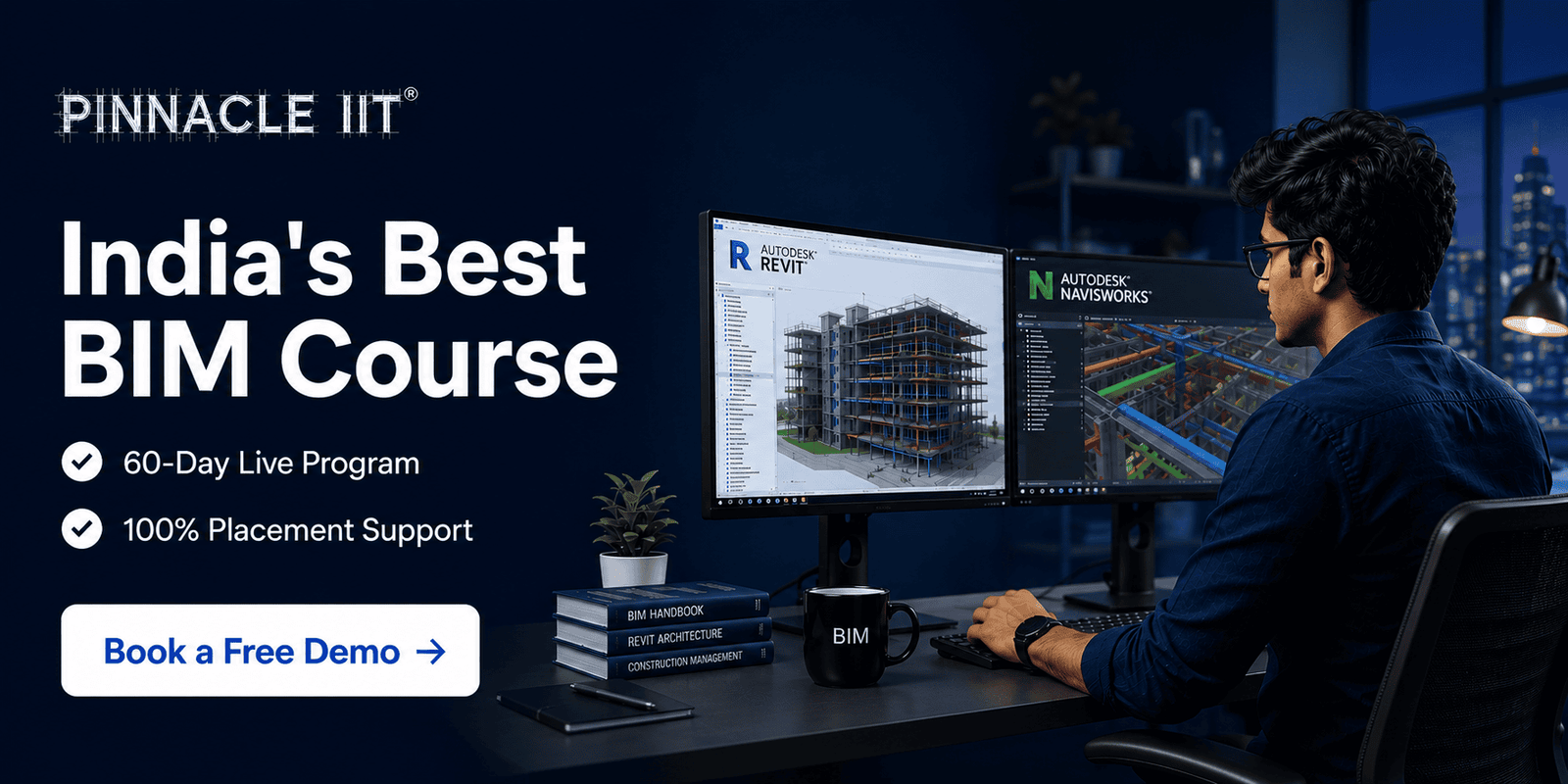
The course covers a suite of essential tools. While Revit is a major component, students also dive into Navisworks for clash detection, AutoCAD for legacy data management, and even Python for BIM development to automate repetitive tasks. Choosing the right tool is vital. Read the Ultimate Breakdown of Revit and AutoCAD.
2. Industry-Specific Modules:
Understanding that a structural engineer has different needs than an interior designer, the BIM Certification Course offers specialized modules. You can focus on MEP coordination, structural analysis in ETABS, or even advanced Scan-to-BIM workflows.

3. Focus on Global Standards:
With the rise of international projects, knowing how to work within global frameworks is vital. The program decodes complex standards like ISO 19650, ensuring that your skills are marketable in the UK, Middle East, USA, and beyond. Understanding international regulations is a core pillar of the BIM Certification Course; learn more at ISO 19650 Decoded: A Guide for Architects and Engineers.

Curriculum Highlights of the BIM Certification Course:-
The journey from a traditional modeler to a BIM leader requires a multi-layered approach. Here is what you can expect from the comprehensive syllabus:
Foundation and 3D Modeling:
Before jumping into the deep end, the BIM Certification Course ensures a rock-solid foundation. This includes:
- Transitioning from CAD to BIM workflows.
- Mastering Revit Architecture and Structure.
- Understanding Levels of Development (LOD) from 100 to 500.
Advanced Coordination and Management:
A project is only as good as its lack of errors. The BIM Certification Course places heavy emphasis on:
- Clash detection and coordination using Navisworks.
- BIM Execution Plans (BEP) and Implementation Plans.
- Common Data Environments (CDE) for seamless team collaboration.
Specialized Emerging Technologies:
To truly future-proof your career, the BIM Certification Course touches upon:
- Scan-to-BIM: Turning point cloud data into intelligent models.
- Digital Twins: Creating virtual replicas of physical assets for facility management.
- AI and Automation: Leveraging tools like Generative Design and AI chatbots to manage construction data.
The “Human” Side of the BIM Certification Course:-
At Pinnacle IIT, there is a strong belief that technology should humanize engineering, not complicate it. The BIM Certification Course emphasizes “Empathy in Design” how better models lead to safer construction sites, more sustainable buildings, and better living environments for communities.
The instructors don’t just teach data entry; they teach problem-solving. Whether it’s finding a way to reduce the carbon footprint of a skyscraper or ensuring a hospital’s MEP systems are perfectly timed for patient safety, the course focuses on the real-world impact of your work.
Placement and Growth Opportunities:-
One of the most significant hurdles for students is finding the right job after training. Pinnacle IIT’s BIM Certification Course is widely recognized for its placement assistance. By connecting students with top global firms, the program ensures that the transition from the classroom to the site office is as smooth as possible.

Conclusion: Enroll in a BIM Certification Course Today:-
The construction industry is at a crossroads. Those who embrace digital tools will lead the next generation of iconic projects, from smart tunnels in Kashmir to sustainable “oceanscrapers” on the global stage. By choosing the BIM Certification Course at Pinnacle IIT, you are investing in a future where you are not just a participant in the industry, but a leader of the BIM revolution.
Don’t wait for the industry to move past you. Take the leap, master the technology, and build a career that stands the test of time.
Frequently Asked Questions:-
1. Who should enroll in this BIM Certification Course?
A. This course is ideal for civil engineers, architects, MEP professionals, and students looking to enter the AECO industry with a competitive edge in digital construction.
2. Does the course include training on multiple softwares?
A. Yes, the curriculum covers a variety of industry-standard tools including Autodesk Revit, Navisworks, AutoCAD, and specialized plugins for clash detection and coordination.
3. Is there a focus on international standards like ISO 19650?
A. Absolutely. A key part of the BIM Certification Course is learning to work according to global standards, which is essential for those looking to work on international projects or abroad.
4. What kind of placement support does Pinnacle IIT provide?
A. Pinnacle IIT offers dedicated placement assistance, connecting certified professionals with top-tier AEC firms and global construction companies.
5. Can I take this course if I have no prior experience in 3D modeling?
A. Yes, the course is structured to take you from foundational concepts to advanced management techniques, making it accessible for beginners while still being valuable for pros.
Read more on:-
For more information about engineering, architecture, and the building & construction sector, go through the posts related to the same topic on the Pinnacle IIT Blogs page.
Find out more accurately what we are going to take off in the course of applying leading new technologies and urban design at Pinnacle IIT.
Subscribe to our YouTube channel and blog websites to obtain all the up-to-date information relating to construction matters.